
5 Engineering Steps Behind BOA’s Modular TactileHead
Turning helmet fit into measurable data
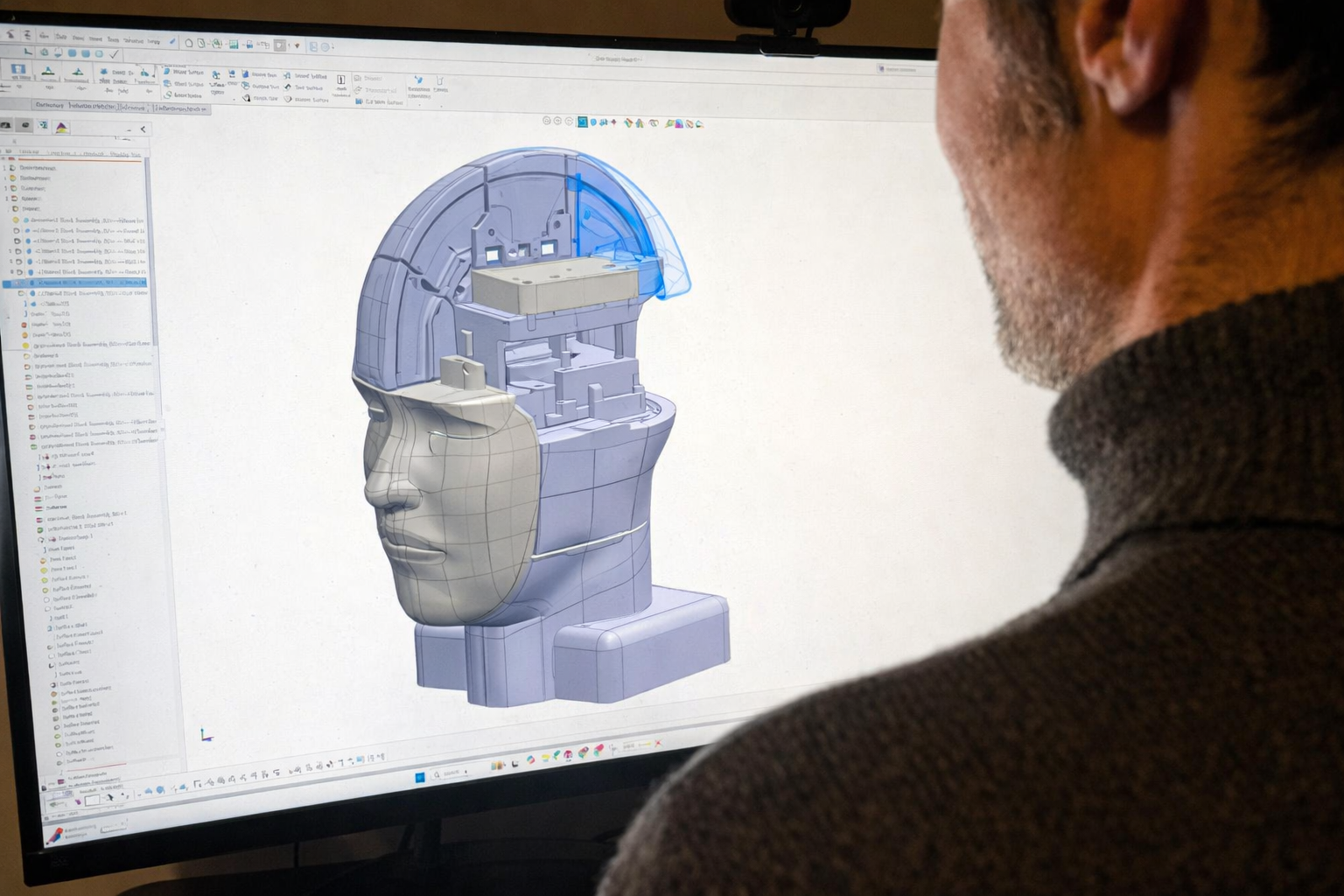
When BOA Technology began investigating how tightening mechanisms influence helmet fit, the challenge was not simply to visualise pressure, but to understand how loads redistribute across the head as the retention system is adjusted.
From the rider's perspective, tightening the dial changes the feel of a helmet immediately. The mechanical behaviour behind that change, however, is far more complex. Forces redistribute across the cranial surface in ways that are difficult to observe directly. Capturing this behaviour required a sensing platform capable of resolving pressure patterns across the complex contours of the human head.
To support BOA's research, PPS configured a customised version of its Modular TactileHead, a segmented capacitive sensing system built to measure pressure distribution across the human head, used across applications including headwear ergonomics and, in this case, helmet retention testing. The project combined mechanical design, sensor architecture and fabrication expertise to create a system capable of measuring subtle changes in load distribution during tightening.
Senior Design Engineer Rob Matthews led the mechanical development of the instrumented head.
The engineering process behind BOA’s custom TactileHead involved several key design decisions.
1. Balancing sensing coverage with manufacturability
The obvious answer is to cover the entire surface with sensors. Electronics, wiring and mounting features make that impossible in a real, manufacturable system.
A tactile sensing platform also has to accommodate the infrastructure required to operate the sensors and assemble the structure, and that infrastructure occupies space within the system, limiting how much of the outer surface can be instrumented.
Rob describes the design challenge as a constant balancing act.
“We would ideally like to place sensors everywhere,” he explains. “But we also have to make room for electronics, wiring and the structural elements that allow the system to be assembled and maintained. The design has to work for the client, but it also has to be something PPS can realistically manufacture.”
The engineering task therefore becomes one of integration: achieving the highest useful sensing coverage while maintaining a platform that can be assembled, serviced and manufactured reliably.
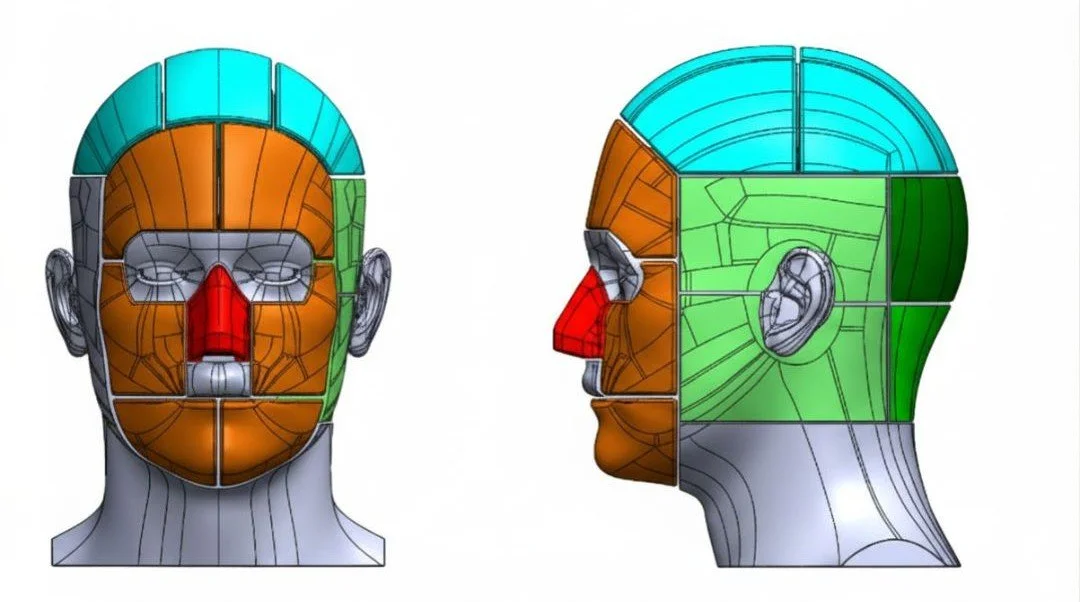
This is the standard segmentation for PPS Modular TactileHead
2. Selecting the right head model
Before sensors can be placed, the physical reference model must be defined.
Many helmet studies rely on ISO standard headforms, widely used in helmet safety testing and impact evaluation. These provide a consistent geometry for experiments.
For BOA’s project, the system was built around a 75th percentile head, slightly larger than the statistical average. Once sensors are designed around a specific surface, changing that shape later becomes extremely difficult, making the initial choice an important decision.
Human heads vary widely in size and proportion, and skull shapes differ between populations. Some projects therefore use scanned head models, while others rely on ISO standards as a practical reference.
Once selected, the head model becomes the foundation for the entire sensing architecture.
3. Dividing the surface through controlled segmentation
With the overall shape defined, engineers must determine how sensors can be distributed across the surface.
Rather than covering the structure with a single sensor, the instrumented surface is divided into multiple sensing modules, each containing a grid of conductive rows and columns that form pressure-sensing elements at their intersections.
This segmentation is not arbitrary. Sensor modules cannot grow indefinitely because electrode counts, signal routing and electronics capacity impose practical limits.
Rob often compares this stage of the design process to assembling a puzzle.
“It’s a bit like assembling a jigsaw puzzle,” he says. “You start placing pieces onto the surface, but each piece affects everything around it. Moving one sensor changes where wiring runs, how modules attach and how much space remains for electronics.”
Because the head is a compound curved surface, modules rarely align neatly. Engineers refine the layout repeatedly until sensing coverage, wiring paths and structural features can coexist.
Segmentation also provides a practical advantage. Since the Modular TactileHead is built from individual sections, modules can be removed or replaced if necessary, allowing the system to be maintained or reconfigured without rebuilding the entire structure.
4. Keeping seams out of the measurement zone
Helmet retention systems typically apply force around the rear of the head. Tightening the dial compresses the helmet structure in this region, redistributing pressure across the cranial surface.
Capturing this behaviour was essential for BOA's research. That meant ensuring sensing coverage across the back of the head remained as continuous as possible.
Interruptions in the sensing surface, such as seams or fasteners, create blind spots where pressure cannot be measured. If these occur in critical regions, they can obscure exactly the behaviour engineers are trying to observe.
To minimise this risk, seams were deliberately kept away from the rear centreline. Instead, the sensing modules were arranged asymmetrically so unavoidable boundaries fell outside the primary measurement region.
This illustrates how the mechanical design of a sensing platform is shaped directly by the measurement objective.
5. Integrating sensors, electronics and structure
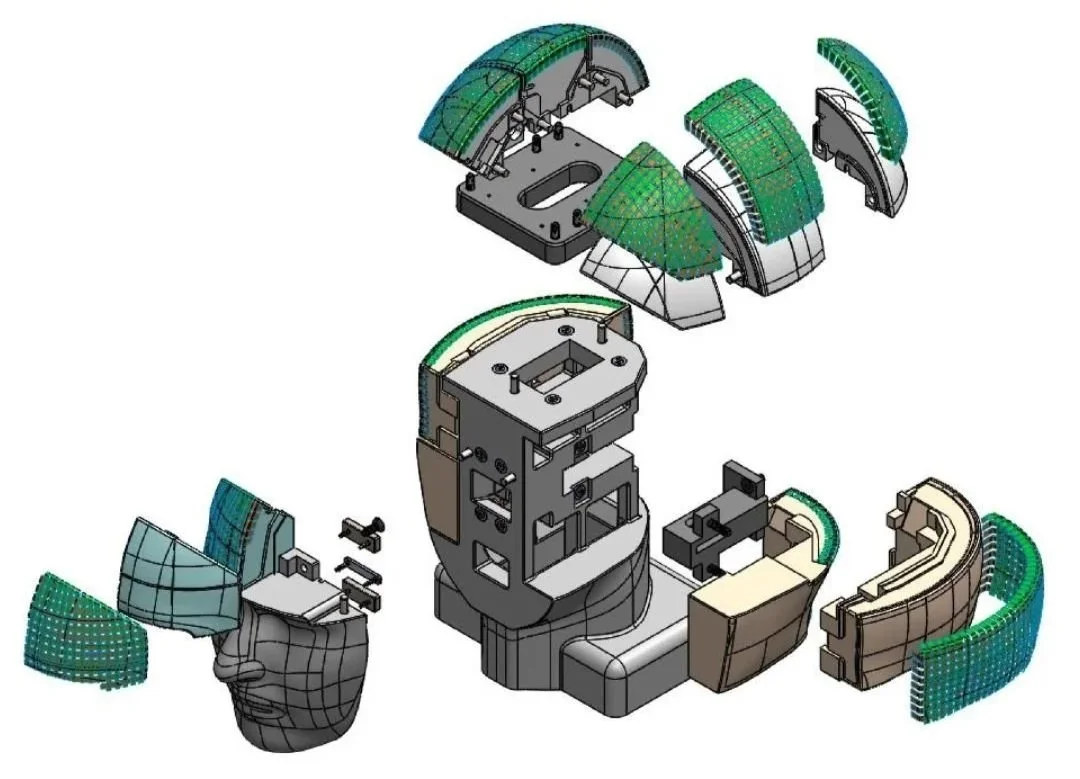
The sensing technology used in the TactileHead is based on flexible grids of conductive fabric electrodes, using a capacitive sensing principle.
Each grid contains rows and columns of conductive material. Wherever these intersect, a sensing element is formed. When pressure compresses the layered sensor structure, the capacitance between the electrodes changes slightly, allowing pressure to be measured.
For BOA’s system, the electrode pitch was designed to remain approximately six millimetres, providing sufficient spatial resolution to capture pressure changes while remaining compatible with the practical limits of sensor fabrication and signal routing.
Because the electrodes are flexible, the sensing grid can conform to curved surfaces. However, mapping a rectangular grid onto a compound curved shape introduces distortion.
Rob describes the challenge with a familiar analogy.
“It’s like trying to wrap a square piece of fabric around a football. Somewhere, the geometry has to adjust.”
Digital modelling tools allow engineers to design electrode paths directly on the curved surface and then mathematically flatten those shapes into fabrication patterns. This workflow significantly reduces the manual trial-and-error that earlier tactile sensor designs required.
Behind the sensing surface, each module is built from a multilayer structure composed of conductive fabrics, dielectric materials and adhesive layers. Although simple in concept, each sensor typically consists of around ten precisely aligned layers, where very small changes in spacing produce measurable pressure data.
Inside the structure, each sensing module also contains electronics that convert the capacitive signals into digital measurements. To avoid disturbing the contact surface, PPS designed an internal attachment system using magnets and locating pins. The magnets secure the modules in place, while the pins prevent them from shifting under load, eliminating the need for exposed fasteners that could introduce pressure artefacts.
Much of this fabrication work takes place at PPS’s Los Angeles facility, where the team has refined the manufacturing process over many years.
From subjective feel to measurable data
Once assembled, the TactileHead becomes a stable measurement platform. When a helmet is fitted and its retention system is tightened, pressure redistributes across the contact surface.
Because the measurement platform remains constant, these changes can be attributed directly to the helmet rather than variability in the test setup.
This allows engineers to observe how tightening mechanisms alter load distribution across the head, helping designers refine retention systems and better understand how mechanical adjustments translate into perceived fit.
In doing so, the Modular TactileHead turns the subjective sensation of helmet fit into quantifiable engineering data.